Blazheiko
Doctor ZhivagoBlazheiko, a miller in Zybushino, helps found a two-week republic that rejects the Provisional Government and breaks with the rest of Russia. His attempt to build a millennial kingdom around collective work and property gives the village’s local revolt an ambitious, religious cast, even as its swift defeat shows how precarious such experiments are amid the upheavals of 1917.
Identity and Background
Zybushino was a small grain center administratively subordinate to Meliuzeievo, though the village was described as ahead of it in every way. Blazheiko belonged to this prosperous, distinctive locality, whose fertile soil, merchants, customs, and regional speech had long nourished stories and exaggerations. The village’s history of legends provides a fitting backdrop for a political venture that soon takes on the scale of a prophecy.
Blazheiko was a religious dissenter who had once corresponded with Tolstoy. His religious convictions were not separate from his politics: he declared a new millennial kingdom in which work and property would be collectivized, and called the local administration an Apostolic Seat. The title joins a communal political program to the language of religious authority.
Founding of the Zybushino Republic
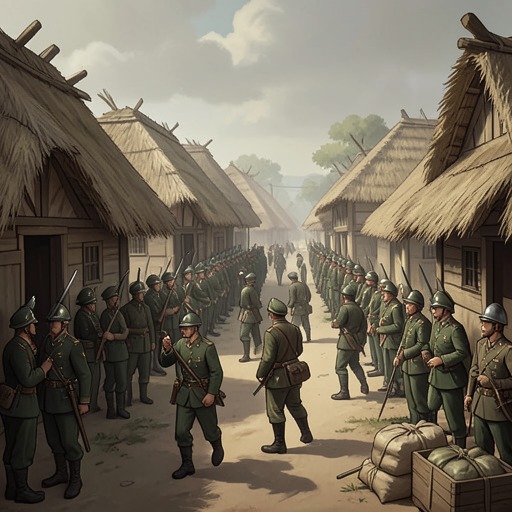
In June, Blazheiko set up Zybushino as an independent republic with the support of deserters from the 212th Infantry. They had left the front during the upheavals, retained their weapons, and reached the village by way of Biriuchi. The new government thus rested on both Blazheiko’s local initiative and the armed presence of men who had already broken away from military discipline.
The republic refused to recognize the Provisional Government and declared its separation from Russia. Its plan to collectivize all work and property made secession more than a change of administration: Blazheiko presented it as the founding of a new social and spiritual order. Yet the account offers no evidence that this program had time to become a lasting system; the republic existed for only two weeks.
Defeat and Aftermath
In July, a unit loyal to the Provisional Government entered Zybushino, ending the republic. The deserters retreated to Biriuchi and established a camp in a forest clearing along the railway, among old tree stumps, pilfered timber, and the deteriorating huts of seasonal laborers. The movement’s defeat therefore did not immediately dissolve its armed following; it displaced the deserters from the village into a makeshift camp beside the railway junction.
Blazheiko’s initiative is later recalled when Yurii Andreievich Zhivago asks Maxim Aristarkhovich Klintsov-Pogorevshikh whether he had helped establish the republic. Klintsov-Pogorevshikh answers joyfully that he had, and says that Blazheiko provided the opportunity while Zybushino supplied the place for the application of his own theories. The exchange confirms Blazheiko’s central role but also distinguishes him from the assistant, whose ideas Yurii finds difficult to follow and whose philosophy combines anarchist principles with hunters’ tall tales.
Narrative Significance
Blazheiko’s republic brings together forces that the novel repeatedly places in uneasy proximity: religious expectation, collective ownership, local independence, and armed political rupture. Its Apostolic Seat and millennial kingdom give a village secession the language of sacred renewal, while its rapid suppression exposes the gap between a proclaimed new order and the military power that can end it.
The episode also fits Zybushino’s reputation as a place where fact and legend mingle. The republic is a real, brief political event, but Blazheiko’s religious dissent and the extravagant theories associated with his assistant make it sound like one more of the village’s fabulous stories. Its two-week duration fixes the contrast: an immense claim to begin a new age, followed almost at once by retreat toward the railway.